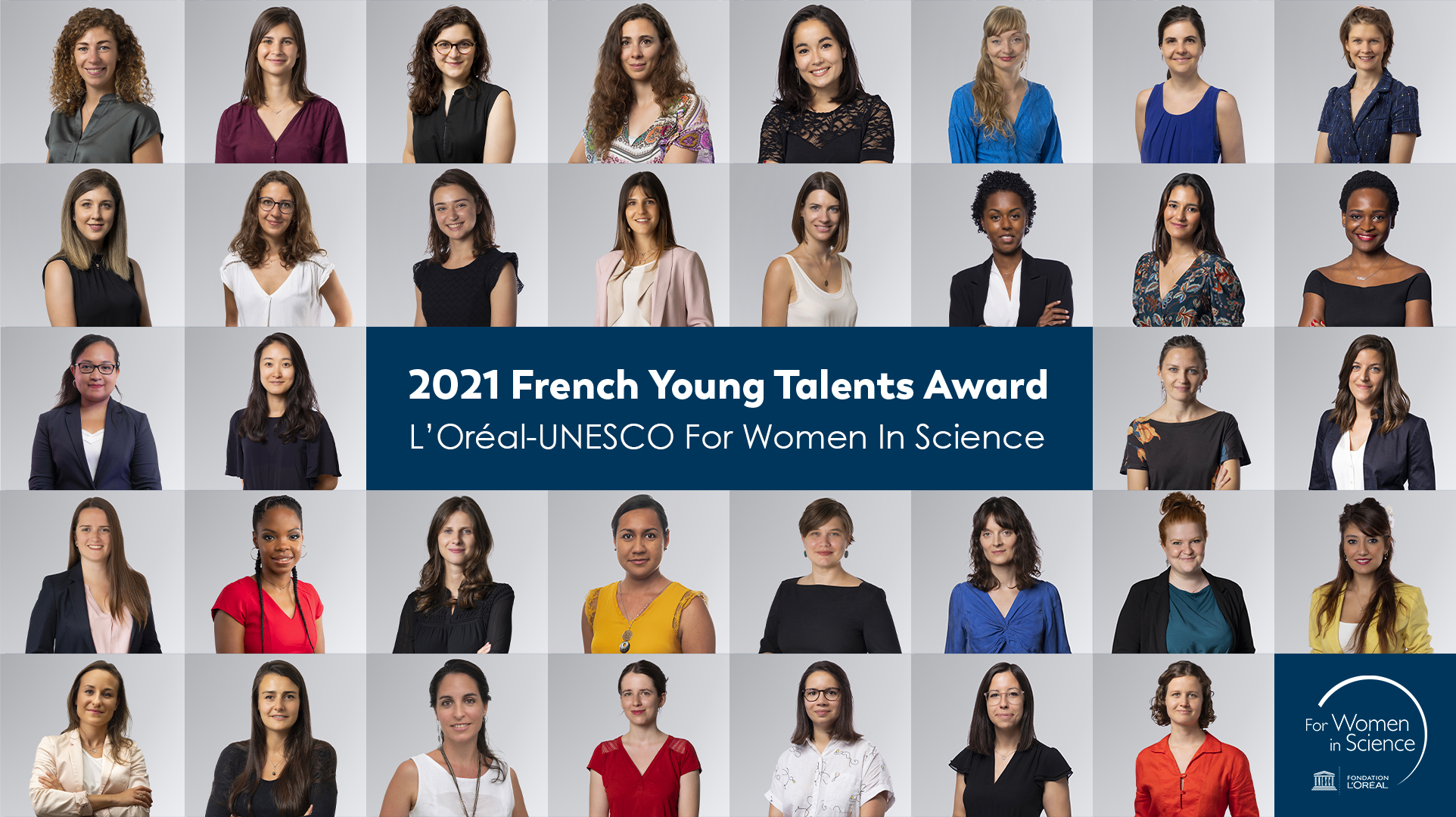
Paris, October 4, 2021 – The COVID-19 crisis has shown us that to address the major challenges facing the world, we must mobilize all talent. To help promote women’s scientific excellence, which remains underrecognized, the L’Oréal Foundation, in partnership with the French Academy of Sciences and the French National Commission for UNESCO, is awarding the 2021 Young Talents for Women in Science France Prize to 35 brilliant young female researchers.
Women remain underrepresented in scientific research: today, they account for only 33% of researchers worldwide, and 28% in France.[1] In Europe, 86%[2] of senior academic positions in the sciences are held by men. And fewer than 4% of Nobel Prizes in science have been awarded to women.
This gap is widening even further due to the COVID-19 crisis. “The past year has put us to the test but has also revealed immense potential for resilience and recovery among women, particularly in the healthcare professions,” notes Alexandra Palt, Executive Director of the L’Oréal Foundation. Women’s perspectives and expertise are absolutely essential for building a resilient, sustainable, and inclusive world. Women must be able to take their rightful place in research, because gender bias limits the scope and impact of future discoveries.”
For the 15th annual edition of the 2021 Young Talents France Award, the L’Oréal Foundation and its partners—the French Academy of Sciences and the French National Commission for UNESCO—reaffirm their commitment to supporting women scientists, raising their visibility, and promoting their contributions to research.
This year, 21 doctoral students and 14 postdoctoral researchers were selected in France from among 740 applications by a jury of experts composed of 28 researchers from the French Academy of Sciences.
These promising scientists received a grant (€15,000 for doctoral students, €20,000 for postdoctoral researchers), which will help them continue their research. They also received training in leadership (management, negotiation, public speaking, etc.) aimed at equipping them with additional tools to better tackle the glass ceiling, which remains a reality in the world of research.
Hailing from mainland France and the overseas territories, and working in a wide variety of research fields (genetics and ecology, treatments for female infertility, studies of viruses and chronic diseases, astronomy, cybersecurity, etc.), many of these young female researchers want to share and pass on their passion for science to inspire the scientists of tomorrow. “It’s important to have a supportive ecosystem made up of other women in order to gain the confidence needed to achieve one’s career goals ,” says Dorien Maas, a postdoctoral researcher in psychiatry and neuroscience. Similarly, biologist Jessika Consuegra asserts that “anyone, regardless of income, background, or gender, should be able to find their place in science.”
To foster a new generation of outstanding female researchers, the L’Oréal Foundation, in partnership with UNESCO, awards grants each year in more than 110 countries, through its national and regional Young Talents programs For Women in Science, nearly 250 grants, which aim to provide specific support to doctoral and postdoctoral researchers at a key moment in their careers.
Biological Sciences – Engineering
Maëlle Bellec – Unraveling the mysteries of embryonic development
Morgane Boulch – Developing immunotherapy to fight cancer
Jessika Consuegra – Identifying the positive effects of gut microbiota bacteria on their host
Claire Dessalles – Developing new therapies by studying how cells respond to mechanical forces
Océane Dufies – Improving the detection of pathogenic bacteria to boost immunity
Anne-Gaëlle Goubet – Treating bladder cancer with immunotherapy
Dorien Maas – Developing new therapeutic strategies for the treatment of multiple sclerosis
Young Kyoung Park – Developing yeast through metabolic engineering to produce microbial oils as alternatives to fossil fuels
Judith Pineau – Characterizing the polarization dynamics of B lymphocytes in the immune response
Laura Poillet-Perez – Understanding the mechanisms involved in leukemia resistance to therapies
Lauren Reynolds – Understanding the developmental origins of psychiatric disorders and improving their treatments
Marie Villares – Studying a bovine parasite to identify new cancer treatments
Marion Rincel – Preventing the development of chronic diseases
Marjorie Whitfield – Identifying the genetic causes of male infertility to improve treatment
Health Sciences – Medicine
Sophie Bavard – Explaining our decision-making processes through neuroscience
Gladys Gutiérrez Bugallo – Identifying modes of viral transmission by mosquitoes in Cuba
Nour El Houda Mimouni – Developing treatments for polycystic ovary syndrome
Cécile Tran Kiem – Developing mathematical and statistical approaches to study the COVID-19 pandemic in France
Environmental and Earth Sciences
Felambinintsoa Cathucia Andriamihaja – Understanding the evolution and biology of a group of orchids with a view to their conservation
Lovely Euphrasie-Clotilde – Characterizing the impact of African dust storms on air quality in the Caribbean basin
Pauline Palmas – Assessing the threat of invasive alien species to island biodiversity
Physics and Chemistry
Anaïs Abramian – Modeling natural flows to predict their behavior
Laëtitia Baringthon – Increasing computer processing power
Eszter Dudás – Modeling the atmospheres of distant giant planets
Marina Katava – Thermodynamics as a tool for creating new data storage media
Daphné Lemasquerier – Modeling the dynamics of Jupiter’s atmosphere through fluid mechanics experiments
Tepoerau Mai – Anticipating health risks associated with toxic microalgae in New Caledonia
Alice Marcotte – Studying the physics of nanofluidic flows to design high-performance membranes
Laura Scalfi – Modeling interfaces between a metal and a liquid at the molecular scale for energy storage
Nour Skaf –Developing instrumental tools for observing exoplanets
Mathematics and Computer Science
Stella Bitchebe – Reducing the carbon footprint of data centers while improving their security
Gabrielle De Micheli – Securing information exchanges through cryptanalysis
Melpomeni Dimopoulou – Storing digital data in synthesized DNA
Lucile Laulin – Studying the random walk of an elephant and its applications in statistical physics
Laura Monk – Describing random hyperbolic surfaces
Follow the L’Oréal Foundation on Twitter @4WomeninScience
#FWIS #L’OréalFoundation
[1] Source: UNESCO, 2017: http://uis.unesco.org/en/country/fr?theme=science-technology-and-innovation
[2] She Figures, 2018.